 Region :
Join Us
Join Us


Why Small Town Tourism in Canada Is Struggling with Outsourced Strategies
Here is the truth most people in tourism circles will not say out loud: Imagine that, people not wanting to speak out against the status quo. Not this cat. I say it like I see it. This article is long, but there is a lot to share. For some this may just change the way you promote your small town; you save some money and generate far better results. So.... here we go.
For over 65 years platforms and programs have been built for urban centres. That leaves 70% of Canada scrambling to make it work for them. Small towns across Canada have been trying to grow tourism using urban strategies, programs, and platforms for decades. In that time, regional tourism associations have played a major role in shaping small town strategies. But they also have created gaps, distance, normality, and cookie-cutter strategies.
Distance from the community changes tourism outcomes because decisions are made without real local insight. When you are not on the ground, you miss what actually makes a place work. You lack insight from talking to travellers who are visiting your community. You are not knowledgeable about the benefits of the many tourism assets and how travellers interact with them. You are. You are. You are. I could go on forever.
This article explains why local presence matters in tourism, how marketing from outside sources lacks credibility, how it affects visitor experience, and why small towns and rural regions are sick and tired of being told how to market their backyards from people who may have never visited them or explored their adventures. Later we will look at one program designed for small towns, addressing the challenges of time, skills, funding, and staffing.
Let's start with what small communities do to stay authentic and competitive on the global stage.
Why being on the ground matters
What gets missed from a distance
How to improve tourism outcomes
Helpful Resources
When tourism marketing is not grounded in real, on-the-ground experience, it misses how a place actually functions day to day. This matters because travellers increasingly seek authentic, local knowledge, not polished summaries from suit-and-ties in an ivory tower. Without direct presence, key details are overlooked, including local habits, hidden places, and timing that shape the visitor experience. The reader will understand why distance weakens accuracy and how being physically present leads to more useful, trustworthy, and effective tourism messaging.
When local details are missing, destination marketing loses its edge. It starts to feel generic, predictable, and disconnected from the actual place. Travelers are not searching for "a region with diverse experiences." They are searching for a quiet fishing lake, a hidden trail, or a café locals swear by. Without those specifics, your message blends in with everywhere else.
This is where many strategies fall short. They focus on broad appeal instead of real experiences. The tone becomes polished but hollow. It might look good in a campaign, but it does not help someone picture themselves there. And if they cannot picture it, they will not choose it.
How Does High-Level Tourism Marketing Dilute Small Town Identity?High-level regional tourism marketing is built to cover large areas, and that creates a trade-off. To represent multiple communities, messaging becomes generalized. It has to include everything, which means it cannot go deep on anything. Vagueness does not sell experiences.
The result is safe, wide-reaching language that smooths out the differences between towns. Unique places begin to sound the same. A small town with a distinct personality gets folded into a regional narrative that does not quite fit. And in that regional narrative, the urban cities receive most of the coverage. In many cases small towns are void of any mention. Huh?
For small towns and rural regions, this dilution matters. Identity is the advantage. It is what sets one town apart from the next. When that identity is softened to fit a broader brand, the strongest selling point disappears. Unfortunately, because of the lack of real experiences in those small towns, it is very generic.
The shift is simple but often overlooked. Strong destination marketing does not start at the regional level. It starts on the ground, with real stories, real places, and details only locals can provide. So let the locals run with it.
Further in the article we will share some platforms and programs built for locals and small towns to market themselves successfully on the cheap. Why have you not heard of them? Because they are not developed by regional, provincial, or national tourism associations. God knows they do not want you to think any of us outside their grasp can think on our own.
Sameness is one of the fastest ways a small town loses its edge. When every destination starts to look and sound alike, travellers stop seeing reasons to choose one place over another. It becomes background noise. The same phrases. The same imagery. The same tone. The same promises of "hidden gems" and "authentic experiences" that never quite feel different.
For small town tourism, this is more than a branding issue. It is a visibility problem. If a visitor cannot quickly understand what makes your town distinct, they move on. Choice is everywhere, especially in Canada, where natural beauty is not rare. Lakes, trails, mountains, and charming streets exist in hundreds of communities. What makes the difference is how clearly a place communicates its unique story.
Sameness often happens when communities rely too heavily on outside messaging or copy what seems to be working elsewhere. It feels safe. It feels proven. But it strips away the very thing travellers are searching for—something real and specific.
The result is predictable. Marketing blends together. Engagement drops. And local businesses feel the impact when fewer visitors convert from interest to action. Small towns do not need bigger messages. They need sharper ones. Distinct beats generic every time. Real people beats corporate towers every time.
Generic tourism branding flattens identity. It replaces real, lived experiences with polished but interchangeable messaging. Instead of showing what actually makes a town different, it leans on broad descriptions that could apply almost anywhere.
You see it in the language. "A place to unwind." "A hidden gem." "Something for everyone." These phrases are not wrong, but they are empty without context. They do not tell a traveller why this town matters over the next one on the map. There is no pride of ownership in the voice of the text.
You see it in the visuals too. Stock-style photography. Ugh... I cannot stand seeing the same photo on many different sites. Overused scenic angles. Smiling couples that could be anywhere. It creates a version of the town that looks good but says very little. When multiple destinations follow the same old playbook, they start to blur together.
Travellers are sharper than most marketing gives them credit for. They scroll quickly. They compare constantly. And they are looking for signals of authenticity. Specific details. Local quirks. Real experiences that cannot be copied and pasted across regions.
When branding becomes generic, it removes those signals. It tells visitors nothing new. And when nothing stands out, nothing sticks. The towns that break through are not louder. They are clearer. They show personality. They show what only they have. And they are not afraid to sound different doing it.
Because timing is everything. And most small towns are always late to their own party. Mostly because they are getting bad advice. Urban advice.
A great event happens Saturday. Locals know it. Visitors feel it. Energy is high. Then what happens?
Silence. Ugh... again.
Content shows up two weeks later on their regional and community website looking polished and proud like it just discovered something everyone already missed. That is the problem.
A 2023 study from Destination Canada showed that over 70 percent of travellers make decisions based on recent or real time content. Not last week. Not last month. Right now. If you are not showing up in the moment, you are not even in the conversation. And small towns feel this the hardest. So... involve the community and postings are up right away. Why? Because they care.
Most regional tourism strategies are built on schedules. Campaign calendars. Approval chains. Design queues. By the time anything gets posted, the spark is gone. That perfect fishing window on Nicola Lake. Gone. That unreal sunset hike locals were talking about. Gone. The rodeo everyone loved. Already packed up and heading down the highway. Opportunity does not wait for approval.
Regional strategies spread money across massive areas. Sounds fair on paper. But in practice, it waters everything down. A small town might get a slice of attention, but never the full story. So what do communities do? They try to keep up.
Ten thousand on a website. Another twenty on a marketing plan. Then a rebrand two years later because nothing stuck. Rinse and repeat. More money, same results. Why? Becuase it is the same people building and creating year after year. Have they learned anything? It does not seem so.
According to the Tourism Industry Association of Canada, small and rural destinations often operate with less than 20 percent of the marketing budget per visitor compared to urban centres. Yet they are expected to compete for the same eyeballs.
That math does not work. The math never works when small towns are forced to use the same programs and platforms built for urban centres. How can they compete? They don't. And you can feel it in the results.
Flat engagement. Low reach. Content that looks nice but does nothing. No bookings. No buzz. No urgency. No programs built to tackle the challenges of a small town.
Meanwhile, the small town program created by our group is winning and is not waiting. Our clients are posting from the dock. From the trail. From the event while it is still happening. Their posts create a website. It is raw. Real. A bit scrappy. But alive. Because tourism is not about perfect timing. It is about being there when it matters.
And if your content shows up late, so do your visitors. Or worse, they do not show up at all. That is not going to happen under our watch.
Here is the blunt truth. Most regional tourism content sounds like it could belong to anywhere in Canada. Because it often does. It is built to cover ground, not tell stories. So you get polished blurbs about lakes, trails, and viewpoints. Nice. Safe. Forgettable.
But what is missing is the good stuff. The early morning coffee crew that knows everyone's name. The horseback riding adventure that had a picnic at the summit. The fishing hole locals caught a big trout at. The trail that only makes sense if someone shows you where it starts. That is the difference between content that fills space and content that fills rooms.
And travellers know. They can feel when something is written from a desk in Vancouver about a town 5 hours away. It feels staged.
Why Do Visitors Trust Authentic Local Tourism Content More?
Because real beats perfect. Every time. Imagine receiving authentic content as it happens, not after it happened. When content comes from someone who actually lives there, it carries weight. It sounds different. It reads different. It hits different. It speaks local not suit-and-tie.
No big production. Just real people showing real places in real time. And that is what builds trust. Because travellers are not just booking places anymore. They are buying into stories they believe. And when locals tell the story they fill the room.
How Are Small Towns Taking Back Their Tourism Story?Quietly. But effectively. Small towns are starting to say, enough.
Enough waiting three weeks for content approval while the best weekend of the year comes and goes. Enough waiting for years for their regional tourism association to visit their community. Enough product launches for their area without even being consulted. Enough generic messaging that makes their town sound like the next one down the highway. Enough with the same content I read last year this year. Enough. Enough. Enough!
Instead, one small town, a pilot project is turning small town tourism on its ear. The locals are picking up the phone. Shooting the video. Posting the moment while it is still happening. Not perfect. But present. And it works.
A report from Skift shows destinations using real time, locally driven content see up to 2 times higher engagement compared to scheduled campaign content. That is the Experience community Program created by EH Canada Marketing Group. Over 1200 communities researched. Over 5 years in the making so we get it right. Because timing matters. Because voice matters. Because being there matters. We will talk more about this award winning program in a sec.
Is Community Driven Tourism Replacing Top Down Marketing?Not replacing. Outperforming. The smartest towns are not cutting ties with regional partners. They are balancing them.
Regional brings reach. Local brings truth. And truth is what converts. So what you are seeing now is a shift. From top down control to ground level storytelling. From campaigns to conversations. From polished to personal.
Something grounded. Something local. Something that actually sounds like the town you are trying to visit. And that is where the opportunity is.
Because the old way is running out of road.
For years, tourism marketing in Canada leaned on polished campaigns built far from the places they were trying to promote. Expensive platforms. High maintenance. Robotic content. Outdated information. And missing the one thing travellers actually trust. Real people.
The Experience Community model flips that.
It is not another campaign stacked on top of everything else. It is a shift in who tells the story. Give locals the tools and the training and let the community control the narrative. Local businesses. Nonprofits. Volunteers. The folks pouring coffee at 6 am. The guide checking river levels before sunrise. The ones who actually live it are posting it. The website is real-time. The website is growing. Who has ever heard of a small town website with 60 pages of information built by locals and constantly changing? Our clients have.
And that changes everything.
Why Are Local Businesses and Nonprofits Driving Tourism Growth when using our platform and training library?
Because they are already doing the work. They just were not part of the marketing in the past.
Now they are.
Instead of waiting for approval, funding cycles, or someone in a regional office to notice, communities are stepping in. Sharing what is happening today. Not next month. Not next season.
And travellers are responding.
According to multiple reports, user-generated and locally driven content can outperform traditional tourism campaigns by two to three times in engagement. In some rural regions, even higher. Our pilot project website traffic is growing 60 to 300% a month!
Why?
Trust. Simple as that.
What Does Authentic Tourism Content Actually Look Like?
It is not curated in a boardroom. It is lived. It is a bit messy. A bit imperfect. And way more believable. That is the edge. Because travellers are not looking for perfect anymore. They are looking for real. They want to feel like they are getting the inside scoop, not the brochure version.
Look at the Nicola Valley. This is our first pilot project.
Through a community driven influencer approach, local voices became the front line of tourism storytelling. Not influencers flying in for a weekend. Locals posting consistently, sharing what matters, when it matters.
The result?
Engagement jumped over 300 percent compared to traditional tourism messaging.
Not because of bigger budgets. Not because of better branding. But because of trust. Because of timing. Because the story finally came from the people who live it every day.
And that is where tourism in Canada is heading. And we built a platform and training program that travellers are asking for. Less polished. More personal. Less waiting. More doing.
And honestly, it is about time.
It is simple. Put tourism back in the hands of the people who actually live it.
The Experience Community Program by EH Canada Marketing Group is not another top down campaign. It flips the script. Local businesses, non profits, guides, and everyday community champions become the storytellers. Not polished. Not delayed. Just real.
And that shift matters more than most tourism boards want to admit. Because, in their eyes, the best marketing comes from a boardroom. In our eyes the best marketing comes from the street. From the dock. From the trailhead at sunrise.
Why Are Local Businesses and Non Profits Driving Tourism Growth Now?
Because they are there. Every day. They live, work and play in the community every day.
They see the moments worth sharing before anyone else does. The café owner who knows when the morning rush hits. The outfitter who knows when the fishing is on fire. The volunteer who captures a festival as it unfolds. This is not theory. It is happening.
In communities using this model, small operators are no longer waiting for permission or funding cycles. They are posting in real time. And that immediacy is what today's traveller is searching for.
Fresh. Local. Right now.
How Does Real Time Storytelling Outperform Traditional Tourism Campaigns?
Traditional campaigns are slow. By the time content gets approved and published, the moment is gone.
Real time storytelling fixes that.
A hiker shares trail conditions today. Not last month. A guide posts a photo of today's catch. Not a stock image from last season. A bakery shows the line out the door on a Saturday morning. It feels alive. Because it is. And performance follows.
Engagement rates climb because the content answers the exact question travellers are asking in the moment. What is it like right now?
What Does Authentic Tourism Content Actually Look Like?
It looks a bit rough around the edges. We like it that way.. And that is the point.
It is not scripted. Not over edited. Not filtered to death. It is a quick video. A candid photo. A short caption. A story blog that sounds like a real person. Because it is a real person. And travellers can tell the difference in about three seconds.
Case Study How the Nicola Valley Proved This Works
Look at the pilot project we are finishing up in the Nicola Valley. Through a community driven influencer approach, locally created content increased engagement by over 300 percent compared to traditional tourism messaging.
Three hundred percent!!
Not because of bigger budgets. Not because of slick branding. Because of trust. Content came from locals who know the land, the seasons, and the stories. And that authenticity cut through the noise.
And more importantly, that is what gets people in the car, on the highway, and into your community.
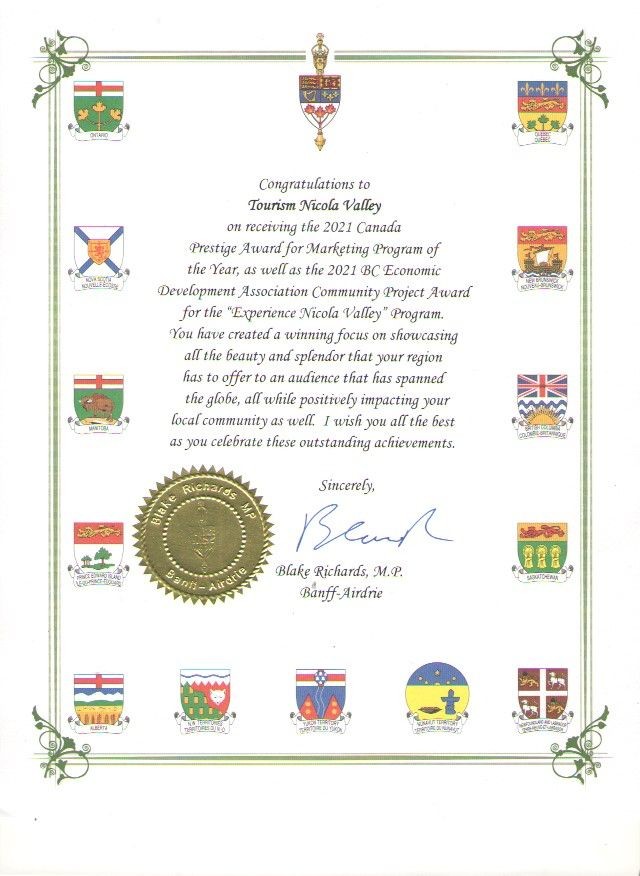
Canada Certificate of Excellence " You have created a winning focus on showcasing all the beauty and splendor that your region has to offer to an audience that has spanned the globe, all while positively impacting your local community as well. I wish you all the best as you celebrate these outstanding achievements. "
Blake Richards – Federal MP – Tourism Critic
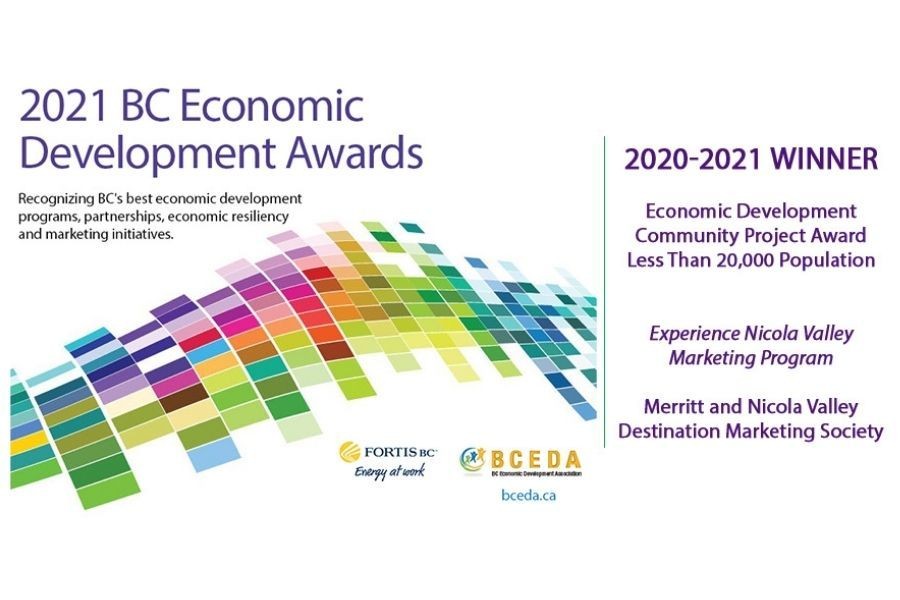
Best Community Marketing Program for communities under 20,000 pop. "the BCEDA has given these awards to individuals and groups who have dedicated their time to community-based economic development." These awards recognize BCEDA members' outstanding work in supporting their local economies and making a meaningful difference in their communities."
Dale Wheeldon, BCEDA President and CEO.
Here is the part nobody wants to admit.
Small towns are stuck in a rebuild cycle. Spend 20 to 60 grand on a tourism website every 3 years. Launch it. Celebrate it. Then watch it age out within two or three years. Content gets stale. Staff changes. Momentum disappears. And boom. Time to rebuild again. It is a cycle of mismanagement of funds. That is not marketing. That is maintenance disguised as progress. Community driven platforms flip that script.
Instead of rebuilding, they evolve. Content is added weekly, sometimes daily. Locals post stories. Operators share updates. Events show up in real time. The website stays fresh because the community keeps feeding it. With every post the look and feel of the website changes. How cool is that!
So yeah. You save money.
But more importantly, you stop wasting it.
Why Do Living Tourism Websites Outperform Static Ones?
A static website is like a brochure sitting in a rack at a visitor centre. A living website is the town talking. And travellers can tell the difference.
The community using our platform and training library have seen engagement jump by 2 to 5 times compared to traditional tourism sites. More pages indexed. More long tail search traffic. More time on site. More actual trip planning happening. Because the content answers real questions.
That is AEO and GEO working without anyone calling it that. It is useful. So it ranks.
Can Content Creation Actually Strengthen a Local Economy?
This is where it gets interesting.
When locals start creating content, something shifts. They are not just promoting the town. They are building skills. Writing for search. Shooting better photos. Understanding how Google and AI platforms surface information.
In Merritt, a small community pilot showed local businesses increasing direct online inquiries by over 30 percent after participating in content training. Not ads. Not big campaigns. Just better storytelling and visibility. And those skills do not stay in tourism. They spill into everything. Retail. Real estate. Local services. That is economic development hiding in plain sight.
Is Tourism Marketing Actually Community Development in Disguise?
Short answer. Yes. Long answer. Also yes. Because when a community owns its content, it owns its story. And when it owns its story, it controls how it shows up online. That builds resilience. Less reliance on outside agencies. Less waiting. Less guessing. More doing. More sharing. More momentum.
And over time, that adds up. Not just in visits. But in confidence. In skills. In pride. Which, if you have spent any time in a small Canadian town, you know is half the battle right there.
Seasonality used to box small towns in. Now it can set them free.
Because when content is created by locals, it moves when they move. No waiting on a campaign calendar built six months ago. Winter shows up and boom, snowshoe trails, rink chatter, fresh powder stories start rolling. Fishing hits and suddenly the feed is full of early morning lake shots and "you should've been here" moments. Fall colours turn and the whole town lights up online the same day it happens in real life.
Regional organizations still matter. They bring funding, coordination, and reach.
But storytelling? That belongs to the people living it. No one knows the early ice conditions better than the guy drilling the first hole. No one captures a perfect fall morning like the person walking their dog through it.
The communities we work with are stepping up. Taking ownership. Telling their own stories in their own voice.
And in doing that, they are not just attracting visitors.
They are building pride.
One post at a time.
One story at a time.
One local at a time.
What is the biggest problem with regional tourism marketing for small towns?
Regional tourism marketing often prioritizes broad appeal over local specificity. This leads to generic messaging that fails to highlight what makes each community unique. Small towns can become lost within regional branding, reducing their visibility in search results and making it harder to attract visitors seeking distinct, experience-based travel.
Why is locally created tourism content more effective?
Locally created content reflects real experiences, current conditions, and authentic voices. It captures moments as they happen, which builds trust with potential visitors. This type of content also naturally includes relevant keywords and local details, improving search visibility while delivering a more compelling and believable story.
How does community-driven tourism reduce marketing costs?
Community-driven tourism eliminates the need for repeated website rebuilds and expensive external campaigns. Instead of outsourcing content and updates, locals continuously contribute stories, photos, and videos. This creates a living platform that evolves over time, reducing long-term costs while increasing the value and relevance of the destination's online presence.
What role do local businesses and nonprofits play in tourism marketing?
Local businesses and nonprofits act as primary storytellers within a community-driven model. They share real-time insights, promote events, and highlight experiences from their perspective. This creates diverse, ongoing content that reflects the true character of a destination while strengthening collaboration across the local tourism ecosystem.
How does real-time content impact tourism decisions?
Real-time content shows potential visitors what is happening right now, which creates urgency and relevance. It helps travellers make timely decisions based on current conditions, events, and experiences. This immediacy is more persuasive than outdated or staged content and often leads to higher engagement and conversions.
Why is authenticity important in tourism marketing today?
Authenticity builds trust, which is critical in travel decision-making. Visitors are more likely to engage with content that feels genuine and relatable. Authentic storytelling from locals provides transparency and credibility, making it easier for travellers to connect with a destination and feel confident in their choice.
How does community content improve SEO and AI discoverability?
Community-generated content naturally includes long-tail keywords, local phrases, and geo-specific details that align with how people search. Frequent updates signal freshness to search engines, while authentic language improves relevance for AI-driven platforms. This combination increases visibility, helping destinations appear in both traditional and conversational search results.
Can small towns succeed without relying heavily on regional tourism associations?
Yes, small towns can succeed by building strong local content ecosystems that showcase their unique experiences. While regional associations still provide value in coordination and funding, community-driven storytelling allows towns to control their narrative, improve visibility, and connect directly with travellers seeking authentic, place-based experiences.
Small town tourism works best when the people who live it are the ones telling it. Local storytelling, real-time content, and community participation create relevance, trust, and visibility that outside strategies often miss. When communities lead, tourism becomes more accurate, more engaging, and more sustainable.
If you would like to start your own community content marketing website and training program so your small town is self-sufficient, generating more revenues and growing a new economy contact us and we would be proud to scedule a visit online or in person and present to your community.
Contact: Greg Girard
EH Canada Marketing Group
778-585-1878
This email address is being protected from spambots. You need JavaScript enabled to view it.
When you subscribe to the blog, we will send you an e-mail when there are new updates on the site so you wouldn't miss them.










Comments 1
The point about “distance” is especially strong—there’s a noticeable difference between content that’s been experienced versus content that’s been assembled. When it’s coming from people actually on the ground, you get the small, specific details that inspire connection with a place instead of making it feel interchangeable. Have you seen examples where communities successfully blend regional support with local storytelling without losing their identity?