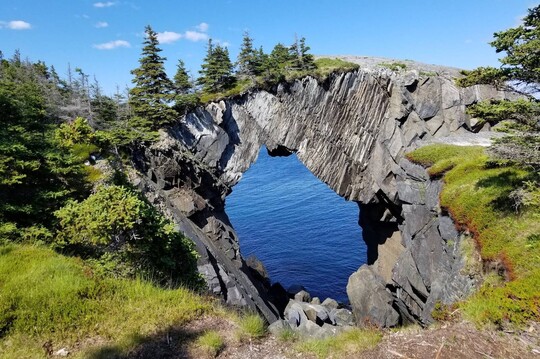
Explore 336 km of Rugged Coastal Wilderness along Newfoundland's Avalon Peninsula
Hiking and Coastal Adventures on the East Coast Trail, Newfoundland, Canada
The East Coast Trail (ECT) is one of Canada’s premier long-distance coastal hiking routes, stretching over 300 km along the rugged Atlantic shoreline of Newfoundland and Labrador’s Avalon Peninsula. Heading north from Topsail to Cape St. Francis before following the coast back south through St. John’s to Cappahayden, this iconic trail system offers hikers an immersive journey atop dramatic sea cliffs, into remote coves, deep into boreal forests, and through historic fishing communities.
Developed along a system of traditional footpaths, coastal routes, and historic access ways, the East Coast Trail connects more than 30 distinct trail sections, each with its own character and scenery. Hikers experience a landscape shaped by ocean weather, ice, and time—where towering cliffs plunge into the Atlantic, waves crash against sea stacks, and narrow headlands reveal endless ocean horizons. Along the way, colourful communities, historic lighthouses, and archaeological sites reflect Newfoundland’s deep maritime heritage.
Whether tackled as a multi-day thru-hike or explored in shorter day hikes, Newfoundland’s East Coast Trail offers one of the most rewarding coastal hiking experiences in Canada. We thru-hiked the ECT during 17 days in summer, and it is one of our favourite Canadian trails.
Route Description
Rather than a single continuous path, the East Coast Trail is a network of interconnected routes, each ranging from a few kilometres to challenging full-day hikes. Specifically, it consists of 25 paths, each with its own name and character that connect coastal communities along the route. These paths range in length from the 3.8 km Silver Mine Head Path (Torbay to Outer Cove) to the 20.4 km Spurwink Island Path (Aquaforte to Port Kirwan). Similarly, they range in difficulty from easy coastal strolls like the Father Troys Trail (Flatrock to Torbay) to strenuous hikes like the Cape Broyle Head Path (Cape Broyle to Calvert).
In general, sections in the northern and southern parts of the route tend to be longer, more remote, and include more challenging terrain. In contrast, paths around the St. John’s area tend to be shorter, and the communities they straddle offer more amenities. However, distances between coastal villages can be substantial, and hikers should always plan carefully, bringing plenty of water, food, a good map and a reliable set of GPX tracks, and plenty of layers to prepare for sudden and unexpected changes in weather. In addition, trail difficulty varies from moderate coastal walks to strenuous backcountry hikes requiring good fitness, proper gear, and awareness of weather and tides.
Trail Amenities on the East Coast Trail
The East Coast Trail is a wilderness hiking route, and amenities vary widely between trail sections. Trail surfaces include packed earth, exposed rock, wooden boardwalks, boggy areas, beaches, and steep staircases built to assist on challenging ascents and descents. There are also sections with steep climbs and descents on rocky, muddy, and loose soil, and some paths stray extremely close to cliff edges.
Wayfinding signage and trail markers are present at major access points and intersections, and most sections are clearly marked with the East Coast Trail Association’s distinctive signage. However, many areas are remote, and hikers are encouraged to carry maps, GPS tracks, and offline navigation tools as cell service can be weak or lacking in remote areas.Facilities such as parking, washrooms, food services, and accommodations are typically located in nearby communities rather than on the trail itself. Camping is permitted in some areas, but hikers must follow Leave No Trace principles and be self-sufficient, particularly on longer or more remote sections.
Wildlife and Nature Along the East Coast Trail
The East Coast Trail passes through diverse coastal and boreal ecosystems, supporting a wide range of wildlife. Seabirds such as Atlantic Puffins, Northern Gannets, Common Murres, and Black-legged Kittiwakes nest along cliffs and offshore islands, making the trail a highlight for bird watchers.
From late spring through summer, hikers often spot whales offshore, including humpback, minke, fin, and occasionally blue whales feeding close to shore. Coastal barrens and forested sections feature hardy plant species, mosses, lichens, and seasonal wildflowers adapted to wind, salt spray, and thin soils.
Moose are common inland, particularly in forested sections, while foxes and snowshoe hares may also be seen. The constant presence of the ocean, shifting weather, and dramatic light creates a powerful sense of connection to nature throughout the trail.
Part of Newfoundland and Labrador’s Signature Trail Network
The East Coast Trail is Newfoundland and Labrador’s most iconic hiking network and one of Atlantic Canada’s premier outdoor experiences. Maintained by the East Coast Trail Association with the support of volunteers and local communities, it plays a central role in regional tourism and outdoor recreation.
The trail connects seamlessly with urban St. John’s, allowing visitors to transition easily from city streets to wild coastal landscapes. In addition, its proximity to the provincial capital makes it uniquely accessible while still delivering a true wilderness hiking experience. Furthermore, the East Coast Trail is also part of the Trans Canada Trail, a 28,000 km multi-use recreational trail spanning Canada from the Atlantic to the Pacific to the Arctic Oceans.
When to Go
The East Coast Trail is best hiked from late spring to fall.
- Late spring (May–June): Cooler temperatures, fewer hikers, active seabird colonies.
- Summer (July–August): Peak hiking season, best whale-watching opportunities, mild temperatures.
- Fall (September–October): Cooler air, dramatic seas, fewer crowds, excellent visibility between fog events.
Winter hiking is not recommended due to ice, high winds, snow, and exposed coastal terrain. Weather can change quickly at any time of year, so layered clothing and proper planning are essential.

 Region :