12 Canadian Projects That Proved Small Towns Still Punch Above Their Weight
From Grain Elevators to Game Changers.
There are small towns across Canada that have punched well above their weight and changed their own trajectory.
I spend a lot of time pointing out where small towns are under pressure, because pretending those pressures don't exist helps no one. But my experience also teaches me this: challenge is only half the story. There are always exceptions to the rule.
There are small towns across Canada that have punched well above their weight and changed their own trajectory. Not by chasing trends or copying cities, but by understanding their assets, setting limits, and making deliberate choices about what they would and would not be.
Taken together with my earlier piece on LinkedIn on the realities small towns face, this follow-up is meant to be practical. These examples show what happens when communities align leadership, business, and volunteers around a clear purpose. They prove that strategy matters, identity matters, and execution matters even more.
My hope is that small towns reading both posts walk away with something usable: a clearer sense of what's possible, what's worth protecting, and where to focus energy for real, measurable impact.
If small towns were actually "dying," Canada would already be finished.
Instead, what we're seeing is a sorting process. Communities that wait for rescue fade quietly. Communities that build with intent write their own comeback story. For business owners, councils, and economic development teams, this is the real playbook for small towns—not theory, but proof.
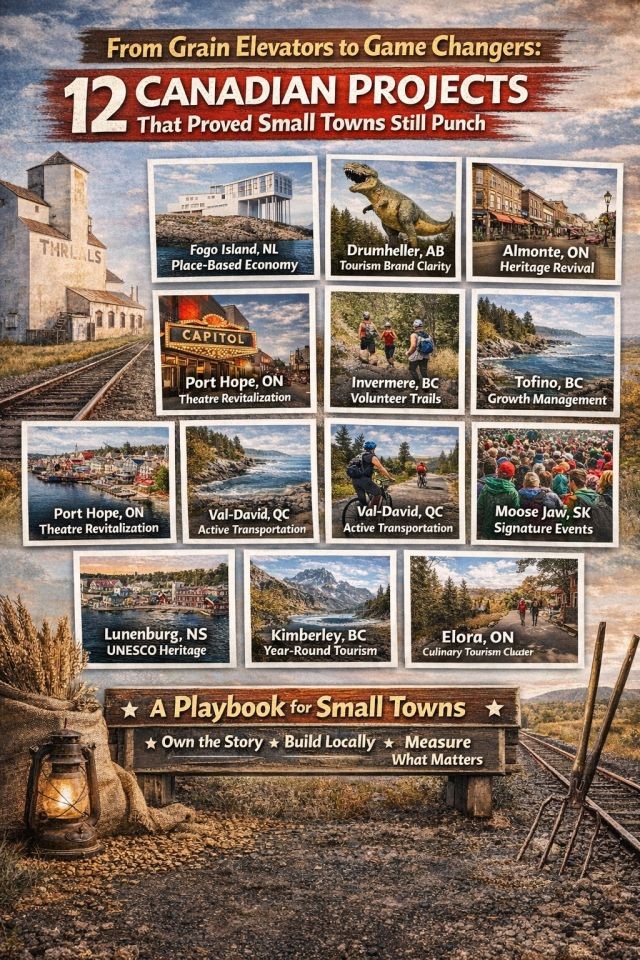
Here are 12 Canadian projects that didn't just survive. They performed.
(1) Fogo Island, NL. Place-Based Economy. This was brought to my attention in my last post and deserves some praise! Fogo Island prioritized local ownership. the program called Shorefast kept tourism dollars circulating locally. Studies show over 60 percent of visitor spending stays on the island.
(2) Drumheller, AB. Brand Clarity. I have visited this community many times in my travels and their branding is consistent and makes them stand out in a crowd. One dinosaur story. Told relentlessly. Over 800,000 annual visitors in a town of 8,000. Consistency beats creativity.
(3) Almonte, ON. Heritage as an Asset. I have been in communities where tearing down old buildings is the norm. I do not buy it. In Almonte, old buildings became economic engines, not liabilities. Downtown vacancy dropped below 5 percent after targeted reinvestment. Nice!
(4) Sackville, NB. Arts as Infrastructure. On my visit it was birding. But where they went all in was in their arts and culture efforts. It is said it has generated an estimated $1.8 million annually. Culture wasn't decoration; it was economic strategy.
(5) Invermere, BC. Volunteer-Led Trails. I volunteer plenty and I am an advocate for the outcomes of a good, supported volunteer program. In Invermere, 10,000 volunteer hours annually fuel outdoor tourism and shoulder-season business growth.
(6) Tofino, BC. Growth Management. Over tourism could be a thing in Tofino,, and some still say it is. Glass half, half empty.But they are taking steps like capping accommodation growth. The community stabilized housing and workforce retention. Fewer rooms. Better margins.
(7) Port Hope, ON. Theatre-Led Revitalization. Quality entertainment in a small town appeals to a region. The Capitol Theatre in Port Hope attracts over 100,000 patrons yearly. Restaurants and hotels followed the foot traffic.
(8) Val-David, QC. Active Transportation. Many communities are going the EV route. We will see where that takes them. Val-David put all their cards into a bike-first planning agenda. It increased retail sales by double digits. Building for locals and visitors rewards you.
(9) Moose Jaw, SK. Signature Events. We had our annual Canada Adventure Seeker company retreat in Moose Jaw. We timed it with their Sidewalk Days Festival. Festivals inject millions annually while strengthening civic pride. Events work when they belong to the place. It was amazing!
(10) Lunenburg, NS. UNESCO Leverage. I was amazed at the history, colours, and waterfront in Lunenburg. Their heritage designation translated into sustained tourism and small business growth without losing authenticity.
(11) Kimberley, BC. Four-Season Tourism. Walking traffic only in this "Bavarian City of the Rockies" was a treat. This small town transitioned from mining to recreation, thus stabilizing the economy and diversifying employment.
(12) Elora, ON. Culinary Tourism Cluster. Food can be a driver, and in this town they appeal to your palate. Their food-driven travel efforts increased overnight stays and year-round visitation.
The lesson for business owners and economic developers
The lesson for business owners and economic developers?
Know your assets. None of these communities chased trends. They invested in identity, limited leakage, and measured outcomes.
This is the playbook for small towns. Own the story. Build locally. Say no when needed. Measure what matters.
Small towns aren't behind. They're just done following bad advice.
12 Canadian Projects That Proved Small Towns Still Punch Above Their Weight
What's killing small towns in Canada is not always what is seems.
 Region :












Comments